
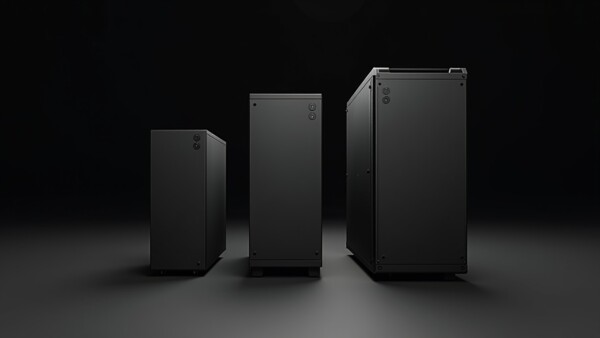
Mini-ITX cases are designed around the 170 × 170mm Mini-ITX motherboard standard. They range from ultra-compact SFF designs under 10 litres to larger ITX towers approaching mid-tower dimensions. This page lists every notable Mini-ITX case available in the UK with specifications.
This page contains affiliate links. As an Amazon Associate, we earn from qualifying purchases at no extra cost to you.
Mini-ITX Case Size Categories
Mini-ITX cases span a wide range of internal volumes, and the category a case falls into has significant implications for component compatibility, cooling headroom, and build difficulty.
Ultra-Compact SFF (Under 10 Litres)
Cases in this bracket prioritise absolute minimum footprint. Examples include the Dan A4-SFX and Lian Li A4-H2O. Both accept full-length, dual-slot GPUs despite their tiny volume, but thermal performance is heavily constrained by the lack of airflow space. Cable routing is extremely tight and component selection must be precise — only SFX or SFX-L PSUs fit, and CPU cooler height is severely limited.
Compact SFF (10–20 Litres)
This is the most popular bracket for Mini-ITX builds. Cases such as the Cooler Master NR200 and Fractal Design Ridge offer a balance between small footprint and practical component support. Most accept full-size GPUs, 240mm or 280mm AIO radiators, and standard SFX or SFX-L PSUs. Build difficulty is moderate.
Standard ITX Tower (20–40 Litres)
Cases like the NZXT H210 and Thermaltake The Tower 100 sit in this range. They are considerably easier to build in, accept longer GPUs, taller CPU air coolers, and in many instances accommodate a standard ATX PSU. Thermal performance is closer to a small mid-tower. The trade-off is that the size advantage over a compact micro-ATX build diminishes.
Larger ITX (40 Litres and Above)
Some full-size mid-tower cases are compatible with Mini-ITX motherboards. These offer maximum component flexibility and excellent cooling headroom, but the rationale for choosing Mini-ITX over micro-ATX or ATX largely disappears at this size. These cases are not listed in the table below as they serve a different purpose.
All Notable Mini-ITX Cases UK — Specifications
| Case | Volume (litres) | GPU clearance | CPU cooler height | Full-size GPU support | Radiator support | Price range | Link |
|---|---|---|---|---|---|---|---|
| Cooler Master NR200 | ~18L | 330mm | 153mm | Yes (up to 3-slot) | Up to 240mm top | £70–£90 | View on Amazon |
| Cooler Master NR200P | ~18L | 360mm | 153mm | Yes (up to 3-slot) | Up to 280mm side, 240mm top | £100–£130 | View on Amazon |
| Lian Li A4-H2O | ~11L | 322mm | 52mm (low-profile only) | Yes (dual-slot, length-limited) | Up to 240mm (side-mounted) | £120–£150 | View on Amazon |
| NZXT H210 | ~26L | 325mm | 165mm | Yes | Up to 240mm front, 120mm top | £80–£110 | View on Amazon |
| Fractal Design Meshify 2 Nano | ~22L | 341mm | 155mm | Yes | Up to 240mm front, 120mm top | £100–£120 | View on Amazon |
| Phanteks Evolv Shift 2 | ~15L | 315mm (vertical orientation) | 65mm (duct-dependent) | Yes (vertical GPU mount) | Up to 240mm | £90–£120 | View on Amazon |
| Thermaltake The Tower 100 | ~33L | 320mm | 180mm | Yes | Up to 240mm | £80–£100 | View on Amazon |
| Silverstone SG13 | ~7L | 270mm | 83mm | Limited (length and slot constrained) | No AIO support | £40–£60 | View on Amazon |
| InWin A1 Plus | ~12L | 290mm | 150mm | Yes (dual-slot) | Up to 120mm top | £130–£170 | View on Amazon |
| Jonsbo U1 | ~8L | 210mm | 80mm | Limited (short cards only) | No AIO support | £50–£70 | View on Amazon |
Price ranges are approximate and reflect typical UK retail pricing. Availability and pricing vary between retailers. All specifications should be verified against the manufacturer’s current documentation before purchasing.
Full-Size GPU Compatibility in Mini-ITX Cases
GPU compatibility is the single most critical concern when selecting a Mini-ITX case for a gaming build. Modern discrete graphics cards have grown substantially in physical size — many flagship models are triple-slot, 340mm or longer, which immediately rules out the most compact options.
There are three dimensions to check before purchasing: GPU length, GPU width (slot count), and in some cases GPU height. Width is frequently overlooked. A 3-slot card in a case designed for a maximum of 2.5 slots will not fit regardless of the quoted length clearance.
| Case | Max GPU length | Max GPU slot width | Notes |
|---|---|---|---|
| Cooler Master NR200 | 330mm | 3-slot | Covers most current mid-range and flagship GPUs |
| Cooler Master NR200P | 360mm | 3-slot | One of the most permissive compact SFF cases available |
| Lian Li A4-H2O | 322mm | 2-slot | 3-slot GPUs will not fit; checks required on card thickness |
| NZXT H210 | 325mm | 2-slot | Tower layout; some 3-slot cards may physically clear but verify |
| Fractal Design Meshify 2 Nano | 341mm | 3-slot | Generous clearance for the volume; suitable for high-end builds |
| Phanteks Evolv Shift 2 | 315mm | 2.5-slot | Vertical orientation; riser cable included |
| Thermaltake The Tower 100 | 320mm | 3-slot | Vertical GPU mount; PCIe riser cable required (included) |
| Silverstone SG13 | 270mm | 2-slot | Short cards only; eliminates most current flagship GPUs |
| InWin A1 Plus | 290mm | 2-slot | Limits GPU options to compact or mid-range cards |
| Jonsbo U1 | 210mm | 2-slot | Very restricted; only low-profile or short-length cards |
When sizing a GPU against a case, always cross-reference the exact dimensions of the specific card model — not just the reference design — as third-party AIB variants frequently differ in both length and thickness from NVIDIA or AMD reference specifications.
PSU Requirements for Mini-ITX Cases
One of the less-obvious costs of building in a compact Mini-ITX case is the PSU form factor requirement. Standard ATX PSUs measure 150 × 86 × 140mm (typical depth varies). The smaller SFX PSU standard measures 125 × 63 × 100mm, and SFX-L extends to 130mm depth to accommodate larger fan diameters and higher wattages.
SFX and SFX-L PSUs command a significant price premium over their ATX equivalents. A quality 650W ATX PSU from a reputable manufacturer typically retails for £70–£100 in the UK. An equivalent-wattage SFX unit from Corsair, Seasonic, or be quiet! generally costs £110–£180. This is a fixed additional cost that should be factored into any compact build budget.
| Case | PSU form factor required | Notes |
|---|---|---|
| Cooler Master NR200 | SFX or SFX-L (ATX adapter included) | Ships with an ATX adapter bracket; ATX PSUs up to ~130mm depth may fit |
| Cooler Master NR200P | SFX or SFX-L | No ATX support; SFX-L recommended for wattage headroom |
| Lian Li A4-H2O | SFX only | SFX-L will not fit; strictly SFX dimensions required |
| NZXT H210 | SFX or ATX | Tower layout accommodates ATX PSU; SFX also supported |
| Fractal Design Meshify 2 Nano | SFX-L (preferred) or SFX | ATX PSU not supported; SFX-L provides better fan size for cooling |
| Phanteks Evolv Shift 2 | SFX or SFX-L | Vertical orientation; ATX not compatible |
| Thermaltake The Tower 100 | SFX or ATX | Accepts ATX PSU; larger internal volume makes this possible |
| Silverstone SG13 | SFX | Budget option, but still requires SFX; adds to total cost |
| InWin A1 Plus | SFX (included) | Ships with a 650W SFX PSU; one of few cases to bundle a PSU |
| Jonsbo U1 | SFX | SFX required; tight internal layout limits cable routing options |
The InWin A1 Plus is notable for including a 650W SFX PSU as standard, which offsets its higher retail price for buyers who would otherwise need to purchase one separately.
Building Considerations
Mini-ITX builds are consistently more challenging to assemble than equivalent micro-ATX or ATX builds, regardless of which case is chosen. Several factors contribute to this.
Component installation order matters. In many compact cases there is insufficient space to install components independently — the CPU cooler may need to be mounted before the motherboard is placed in the case, or the GPU installed before the PSU is connected. Reading the case manual thoroughly before beginning the build is not optional.
Cable management is tighter. The reduced internal volume means there is far less space to route and conceal cables. Modular PSUs are strongly advisable in any Mini-ITX build, as unused cables can otherwise consume a disproportionate amount of available space. Shorter aftermarket cables designed for SFF builds are commercially available and worth considering for the most compact cases.
Thermal headroom is reduced. With less internal volume and fewer or smaller fans, heat dissipation is inherently more constrained than in a mid-tower. High-TDP CPUs and GPUs will typically run warmer in a Mini-ITX case than in a larger enclosure with equivalent cooling hardware. This is a particular consideration for sustained workloads such as video rendering or gaming at extended session lengths.
Airflow path is often restricted. Compact cases frequently have fewer fan mounting positions and smaller fan diameters than larger cases. Positive pressure configurations (more intake than exhaust) are generally preferred in smaller cases to reduce dust ingress and maintain more predictable airflow paths across components.
Upgrade and maintenance access is limited. Once built, many compact Mini-ITX cases require significant disassembly to access components — sometimes including the removal of the GPU to reach the CPU cooler. This is a practical consideration for systems that will be regularly upgraded or maintained.
Despite these challenges, Mini-ITX builds remain a practical choice for users with space constraints, those who value portability, or those who want a capable gaming or workstation system with a significantly smaller footprint than a standard desktop tower.
Related articles: Best PC Cases UK: Complete Guide


