Managing a large product catalogue is one of the most labour-intensive tasks in distribution, wholesale, and e-commerce. Thousands of SKUs. Constant supplier updates. Missing specifications. Inconsistent descriptions. Images that never quite match. AI tools can take on much of this work — here is how.
The Problem with Large Catalogues
Businesses that carry thousands of product lines face a specific set of catalogue problems that manual processes cannot scale to solve:
- Supplier data is inconsistent — product names, specifications, and packaging information vary by supplier and change frequently
- Product descriptions are poor or missing — supplier data sheets give raw specifications but rarely translate to customer-facing descriptions that aid purchase decisions
- New products are slow to list — manually processing a supplier’s new product file, writing descriptions, assigning categories, and uploading images can take days
- Superseded and obsolete products linger — without a systematic process to identify and remove discontinued lines, catalogues become cluttered with products that cannot be ordered
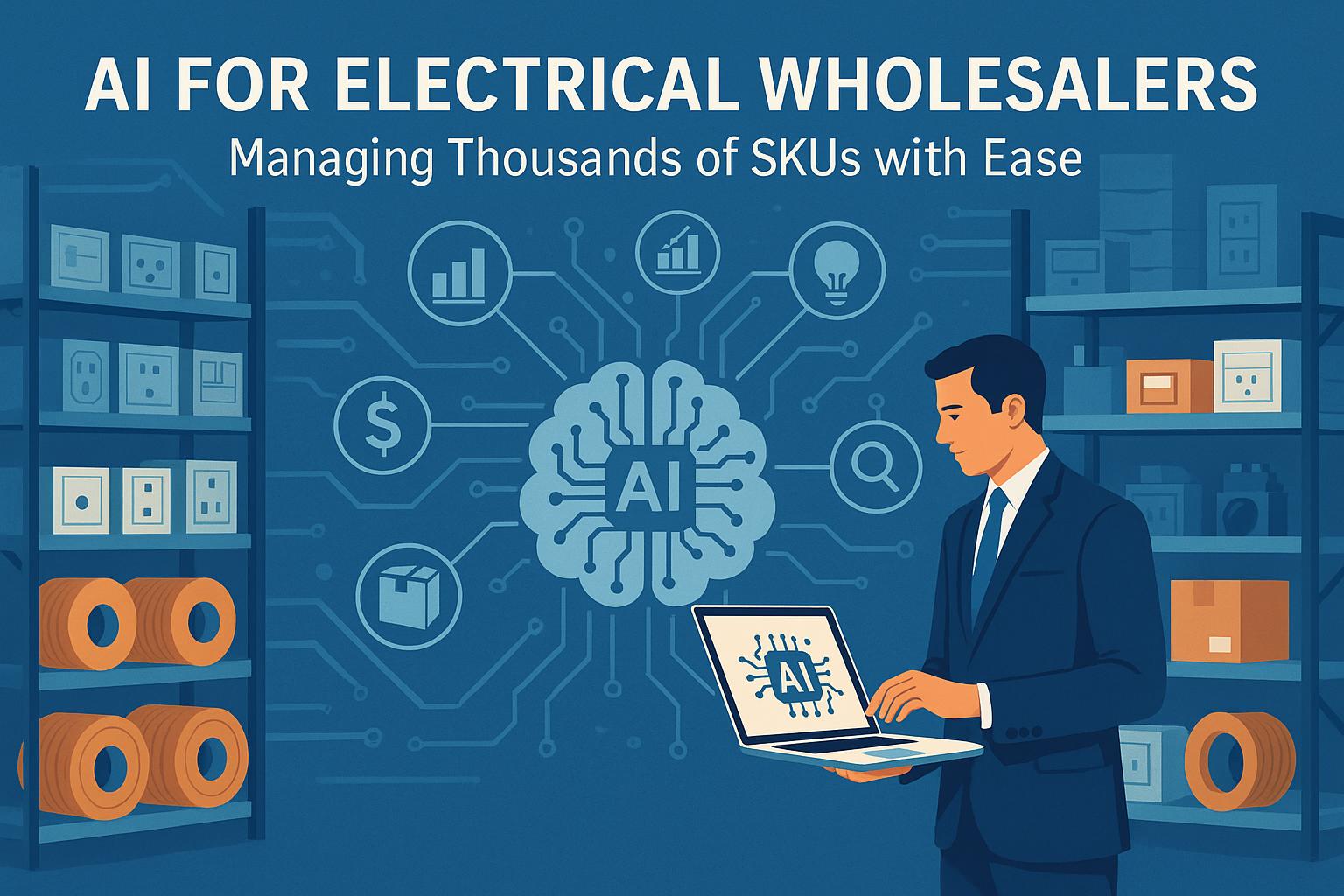
For electrical wholesalers, the scale of this is particularly acute. Data standards organisations like Luckins and ETIM process over 1.5 million product updates annually across the UK electrical supply chain. Staying current manually is not realistic.
How AI Helps with Catalogue Management
Automated Product Data Enrichment
AI tools can take raw supplier data (part numbers, specifications, weights, dimensions) and automatically enrich it — cross-referencing against data standards, filling in missing attributes, standardising naming conventions, and flagging inconsistencies for review.
This is particularly valuable when importing a new supplier’s product range. Rather than manually cleaning and mapping each row of a spreadsheet, AI enrichment tools can process thousands of products in minutes and produce a consistent, ready-to-import dataset.
AI-Generated Product Descriptions
ChatGPT and similar language models can generate customer-facing product descriptions from raw specifications. Feed in the technical data, specify the audience (trade customer, retail customer, contractor) and the length, and the AI produces descriptions at scale.
Example prompt: “Write a 60-word product description for the following electrical component, suitable for an electrical wholesaler’s website. The audience is electricians and contractors. Focus on key applications and key technical advantages. Specifications: [paste specs]”
At scale, this is done via the API rather than the ChatGPT interface — batch processing hundreds or thousands of products programmatically. A developer can set this up in a few hours using the OpenAI API.
Automated Category Assignment
AI classification models can assign products to the correct category in your catalogue automatically, based on product name, description, and attributes. This eliminates the manual triage work when processing large supplier files.
Identifying Superseded and Duplicate Products
AI tools can compare your catalogue against current supplier data and flag products that appear to have been superseded, discontinued, or duplicated under different part numbers. This is especially useful for electrical and industrial catalogues where manufacturers regularly update product lines.
Tools and Approaches
Akeneo (Product Information Management)
Akeneo is a leading Product Information Management (PIM) system with AI-assisted data enrichment and completeness scoring. It centralises product data, highlights gaps, and helps you maintain a clean catalogue across multiple sales channels. Akeneo Growth Edition is free and open-source; enterprise versions are priced on request. Widely used by UK distributors and e-commerce businesses.
Plytix
A PIM tool aimed at smaller businesses, with AI-powered completeness scoring and feed management. Easier to implement than Akeneo and better suited to businesses with 1,000–50,000 SKUs. Plans from around £300/month.
ChatGPT API (for description generation)
For bulk product description generation, the OpenAI API is cost-effective. At GPT-4o mini pricing, generating 1,000 product descriptions typically costs under £5. This is significantly cheaper than outsourcing copywriting and faster than any manual process.
ETIM and Luckins Data Standards
For electrical wholesalers specifically, ETIM (European Technical Information Model) is the dominant product classification standard. Subscribing to Luckins’ data service provides access to standardised product data that can be imported directly into most ERP and e-commerce platforms, eliminating much of the manual data work.
Practical Starting Point
If your catalogue has never been systematically cleaned, start with an audit before implementing any AI tool:
- Export your full product list with key attributes
- Identify products with missing descriptions, images, or specifications
- Cross-reference against current supplier data to find discontinued lines
- Use ChatGPT (free tier) to generate descriptions for a sample batch of 20–30 products — this will tell you how much editing is needed and whether the output quality meets your standard
- If the quality is acceptable, invest in a proper batch generation process via the API or a PIM tool