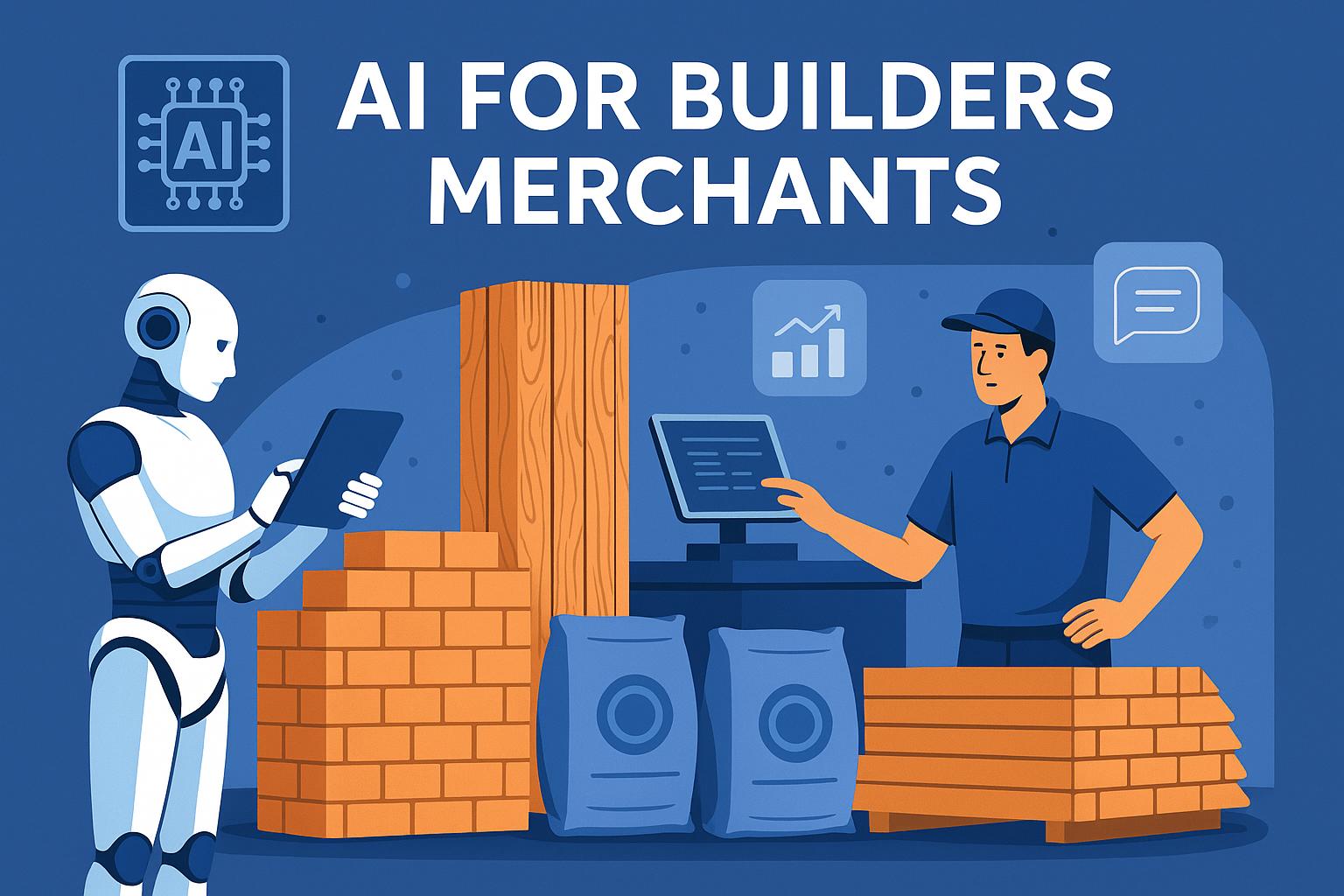
AI in builders merchants is not a future concept — a growing number of merchants are already using AI-assisted tools in their day-to-day operations. This guide focuses on the practical applications: what is available, what it costs, and where it makes the most difference.
The Specific Challenges AI Can Help With
Builders merchants face a set of operational challenges that AI tools are well suited to address:
- Seasonal demand spikes — timber, cement, and aggregates see demand increases of 20–30% in spring and summer compared to winter. Forecasting this accurately prevents both stockouts and yard congestion.
- Bulky stock that cannot easily be over-ordered — yard space is finite, and excess pallets of bricks or timber block operations.
- Complex deliveries — multi-drop routes with heavy vehicles require careful scheduling. Inefficient routing directly increases fuel costs.
- Busy trade counters — staff are expected to check stock, give prices, process orders, and answer product questions simultaneously, often under pressure.
- Manual paperwork — PODs, delivery notes, purchase orders, and credit applications are still paper-heavy in many merchants.
Stock Management and Demand Forecasting
AI-powered inventory tools analyse your sales history, seasonal patterns, and current order commitments to produce demand forecasts and automatic reorder suggestions. For a builders merchant, this means:
- Knowing in February how much timber and brick to bring in before the spring rush
- Flagging slow-moving stock (specific block sizes, specialist products) before it becomes dead stock
- Automatically generating purchase orders to suppliers when stock drops to the right reorder point, rather than waiting for a buyer to notice
Tools to look at: Brightpearl, Cin7, or DEAR Systems (now Cin7 Core) — all integrate with accounting software and handle multi-location stock well.
Delivery Route Optimisation
Route planning software with AI optimisation can cut delivery mileage by 15–25% on multi-drop routes. For a merchant running 3–5 vehicles daily, that is a meaningful fuel and driver time saving.
Modern route optimisation tools take into account vehicle capacity and load constraints (a flatbed carrying timber cannot make the same turns as a standard van), delivery time windows, and real-time traffic conditions.
Tools to look at: Routific, OptimoRoute, and Circuit Route Planner. All have free trials and are priced per vehicle. Routific starts from around £39/vehicle/month.
Trade Counter: Faster Customer Service
Counter staff spend significant time on lookups — checking availability, finding product specifications, quoting prices on alternatives. AI tools can accelerate this in two ways:
AI-Assisted Product Search
Modern ERP systems increasingly include AI-powered search that understands natural language queries rather than requiring exact part numbers. A staff member can type “4-inch class B soil pipe bend” and get results even if the product is catalogued differently in the system.
ChatGPT as a Counter Tool
Some merchants are using ChatGPT informally as a reference tool for counter staff — asking it product questions (“what is the difference between BS6 and BS4449 rebar?”, “what fixing centres for X board on timber frame?”) rather than searching datasheets. This is not a substitute for proper product training but it speeds up answers to edge-case questions.
Reducing Paperwork with AI
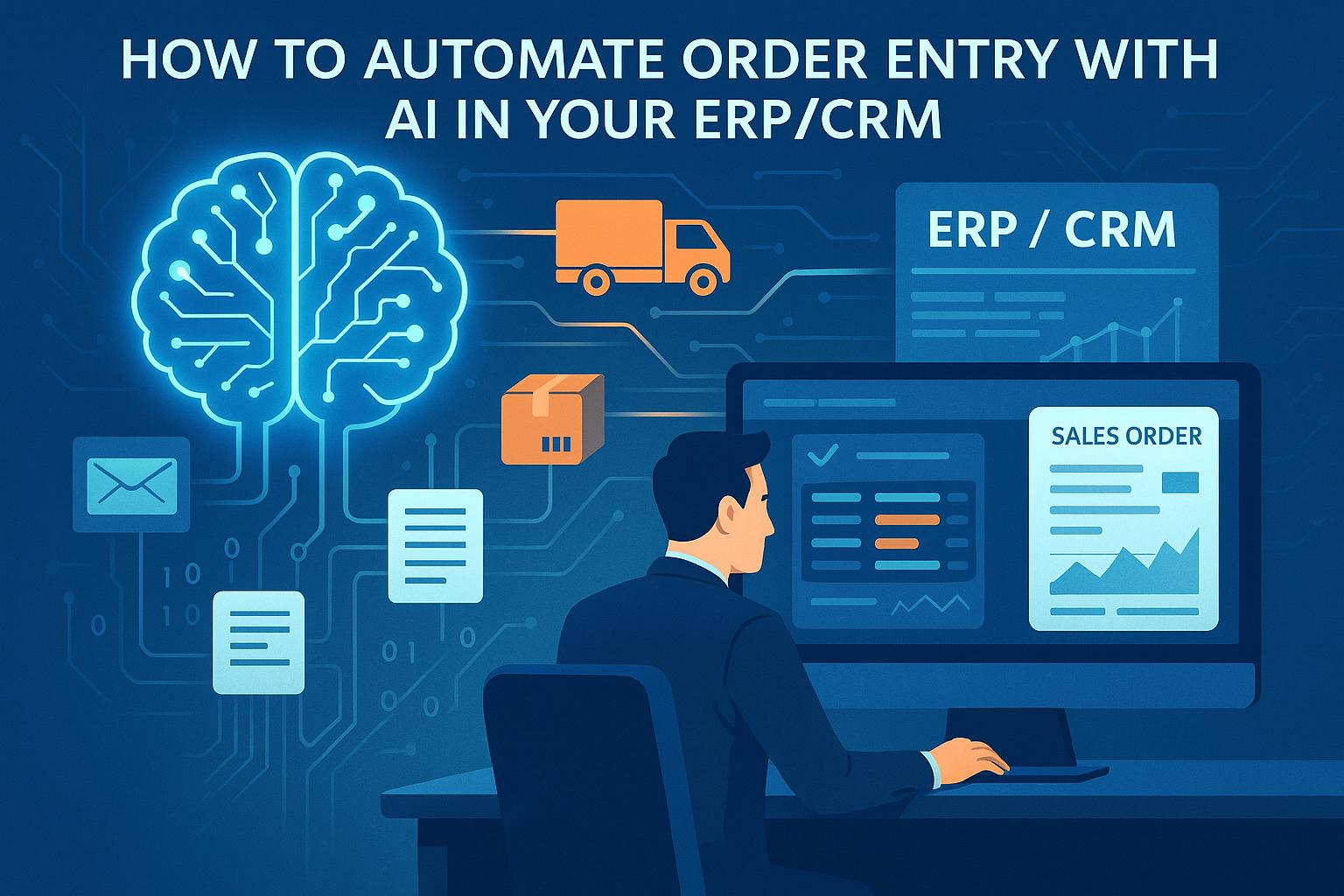
AI document processing tools can extract data from paper-based documents — purchase invoices, delivery notes, credit applications — and enter them into your system automatically. This reduces data entry time and errors.
Tools to look at: Dext (formerly Receipt Bank) for invoice capture; AutoEntry for purchase invoice processing. Both integrate with Xero and Sage and are widely used by UK merchants.
For POD management, tools like Podfather and TransVirtual digitalise the proof of delivery process and can flag exceptions (damaged deliveries, missing items) automatically.
Using ChatGPT for Back-Office Tasks
Beyond operational tools, ChatGPT is useful for builders merchant back-office work:
- Drafting customer communications (credit hold notices, price increase letters, new account welcome packs)
- Writing job adverts for counter staff, drivers, and yard operatives
- Producing health and safety documentation (toolbox talks, risk assessments) as a first draft for review
- Summarising long supplier contracts or terms of business
Where to Start
For most builders merchants, the highest-return starting point is either delivery route optimisation (immediate fuel savings) or AI-assisted stock forecasting (reduces the cash tied up in dead or excess stock). Both have measurable ROI within the first few months.
Start with a free trial of one tool, measure the impact, and expand from there. Do not try to implement everything at once.